Deep Dive: my AI visuals on the Relevatez main stage
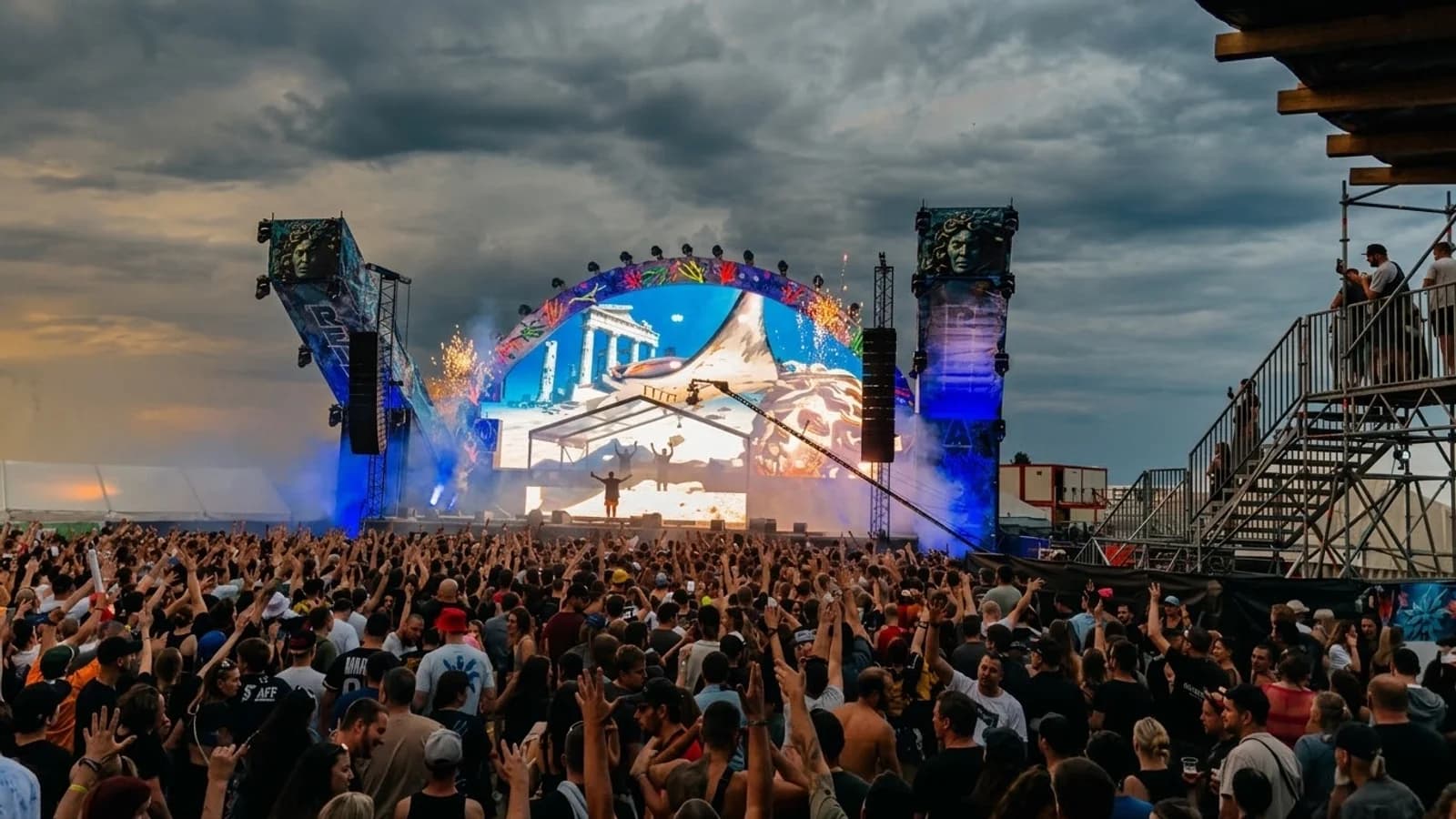
There is a moment at every festival that almost nobody gets to see. The gates are still closed, the grounds are empty, only the crew is doing its final rounds. On a July morning in Ohmstal I stood all alone in front of the Relevatez Festival main stage and watched my images breathe across 28 meters for the very first time.
On the LED arch, a Greek temple was sinking into the sand. Next to it rested a marble Medusa head, half buried, fish drifting past. A world that eight weeks earlier had existed only as a thought: what happens if we take the festival motto Deep Dive literally and turn the entire stage into Atlantis?
A stage is not a screen
The numbers first, because they explain the respect: the stage is 28.41 meters wide in total, the arch opening measures 18 by 10 meters, the towers left and right rise almost 19.5 meters. The video canvas for the LED surfaces is 2016 by 1120 pixels, an odd 1.8 to 1 format. None of this forgives mistakes.
What looks great on a phone can look cheap at ten meters height. Our first version with motifs stretched into the format got thrown out for exactly that reason. The lesson is banal and still constantly ignored: understand the surface first, then design. That was true for posters, it is true for LED walls, and it is especially true for AI.
How Atlantis came to life
The road to the final world was a chain of controlled AI steps. First a deliberately empty base image: bright sandy ground, deep blue water, nothing else. On top of that we built the scene layer by layer. An image edit added the sunken temple in the back left, then the Medusa head in the front right. The stills were rendered at more than 5000 pixels wide and only then cropped to the LED format. You can never have too much sharpness.
My favorite detail from this phase: the instructions to the video model literally included the sentence that the snakes on the Medusa head must remain stone. AI systems love bringing things to life. The art is deciding what does NOT move.
The client saw the first Atlantis draft and replied with a single word: mega. Approval within one afternoon. Anyone who has lived through classic production loops knows what that is worth.
The trick behind the perfect loop
LED surfaces need endless loops, and nothing destroys immersion as reliably as a visible cut. Our trick: the same image serves as start and end frame, and the AI video model computes the 15 seconds in between. Everything that moves enters the frame from the side and leaves it in time, alternating left to right and right to left. The result runs seamlessly, for hours.
That is how a whole zoo of moving motifs for the live operators came together:
- A manta ray gliding silently over the sunken temple
- A shark emerging from the dark and vanishing again
- A mermaid finding her way between the columns
- An expedition submarine with light cones in the blue
- Fire jellyfish drifting through the frame like lanterns
- Dolphins, a sea turtle and a whale silhouette in the deep
And then came Primeshock
Beyond the loops there were special assignments, and my favorite among them: the artist reveals. When a festival announces an act, that is a little dramatic arc of its own. For Primeshock we let the Atlantis world do the work itself: a triton hurls a beam of energy from his trident at a sunken marble tablet, the stone breaks open, and the name of the act is set free. Fifteen seconds, rendered in 4K, straight out of the AI pipeline.
This is exactly where background decoration turns into dramaturgy: the crowd does not read an announcement like this, it experiences it.
Then the people arrived
From July 23 to 26 the grounds were packed, and the quiet morning scene became what you build these things for. When the beat dropped in the evening, the lights flooded the stage and the manta glided across the LED surfaces, thousands of arms went up. Not because of the manta, of course. Because of the moment. But the manta was part of that moment, and that is more than enough for me.
Standing in the middle of it, I briefly thought of my first night shift as a plant guard, of the chat community of a daily soap, of studios and control rooms. It has always been the same craft: making people feel something. Only the tools change. Right now they are changing faster than ever.
What this means for your brand
A visual world of this size would have required a six-figure production budget and months of lead time two years ago. Today it mainly requires three things: a strong idea, someone who truly masters the tools, and a clean process with clear approvals. The technology can be rented. World building cannot.
And this is not just about festivals. Every brand ultimately sells emotions, whether on a stage, in a store or in a 9:16 video. If you want to know how far AI can carry your next production: let's talk. I would love to show you how an empty sandy seabed becomes a world.